
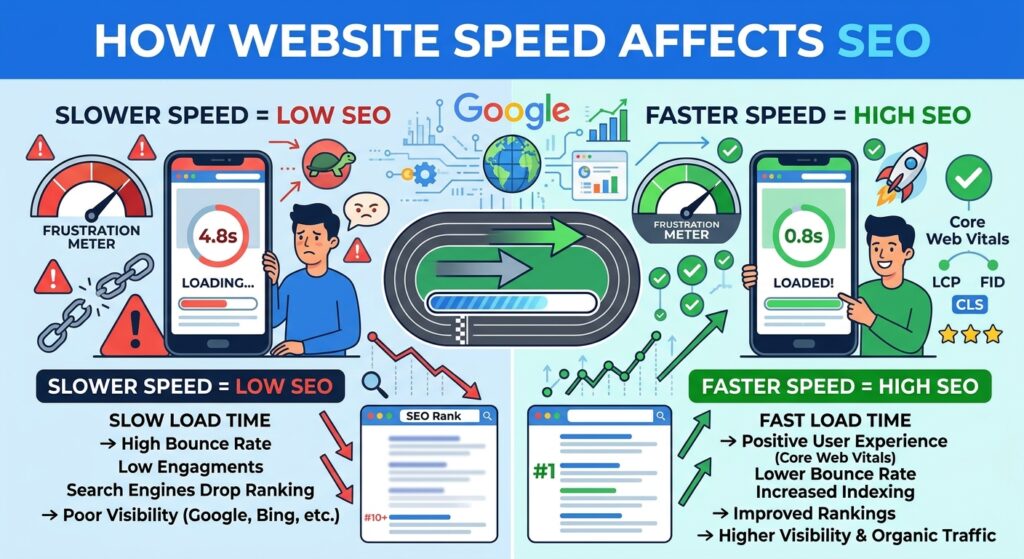
A slow website can frustrate visitors before they even read your content. If a page takes too long to load, people may leave, compare another business, or never reach your contact form. That is why many business owners ask: Does page speed affect SEO?
Yes, page speed can affect SEO. It is part of the bigger page experience picture, along with usability, mobile performance, and how stable a page feels while loading. Google says Core Web Vitals measure real-world user experience, including loading performance, interactivity, and visual stability.
At KSM Media Hut, we see page speed as both an SEO issue and a customer experience issue. A faster website helps people find what they need without friction.
How Page Speed Impacts Your Google Rankings and Conversions
Page speed matters because search engines want to show helpful pages that give users a smooth experience. If two pages are similar in quality, the page that loads faster and works better may have an advantage.
Speed can affect:
- How long visitors stay
- How many pages they view
- Whether they contact you
- How easily Google crawls your site
- How your website performs on mobile
KSM Media Hut includes speed checks inside our SEO services because rankings, usability, and conversions all work together.
How Page Speed Influences Bounce Rate, Engagement, and Conversions
People do not like waiting. If a website feels slow, visitors may leave before seeing your offer, reading your service page, or clicking your CTA. This can hurt business results even if rankings stay the same. A slow page may still get traffic, but it may convert poorly. For example, a visitor searching for a local service may open three websites. If yours loads slowly and a competitor’s site opens quickly, the competitor may get the call first. That is why speed is not only technical. It affects trust.
What Are Core Web Vitals and Why Do They Matter for SEO?
Core Web Vitals are Google’s way of measuring important parts of page experience. They focus on how real users experience your website.
The main areas include:
- Loading speed: How fast the main content appears
- Interactivity: How quickly the page responds
- Visual stability: Whether content shifts while loading
A page that jumps around, loads slowly, or responds late can feel frustrating. Even if the content is good, the experience may push users away.
Does a Faster Website Always Mean Better Rankings?
Not always. A fast website with weak content will not automatically outrank a slower page that answers the search better. Google says good Core Web Vitals do not guarantee top rankings because page experience is only one part of search performance.
At KSM Media Hut, we do not treat page speed as a shortcut. We treat it as support for better SEO. Strong content, clear structure, useful answers, and technical performance should work together.
What Slows Down a Website? 8 Common Causes
Many websites become slow because of small issues that build up over time.
Common causes include:
- Large image files
- Too many plugins
- Poor hosting
- Heavy page builders
- Unused code
- Too many tracking scripts
- Videos are loading too early
- Weak mobile optimization
A proper speed review can show what is really slowing the page down. Guessing often leads to wasted time.
How Can You Improve Page Speed?
Improving page speed usually starts with the basics. You do not always need a full rebuild.
Helpful steps include:
- Compressing large images
- Using better hosting
- Reducing unnecessary plugins
- Cleaning unused code
- Enabling caching
- Using lazy loading for images
- Optimizing mobile layouts
- Testing key pages regularly
KSM Media Hut also connects speed improvements with Semantic SEO because fast pages still need clear topics, helpful structure, and strong content meaning.
Why Mobile Speed Is So Important
Many users visit websites from phones, especially when searching for local services. If your mobile site loads slowly, buttons are hard to tap, or images shift while loading, people may leave quickly. Mobile speed matters because mobile users often have high intent. They may be ready to call, book, buy, or request a quote. A fast mobile page can make that decision easier.
How Page Speed Supports AEO and AI Search
Answer-based search depends on clear, accessible information. If your pages are slow, messy, or hard to crawl, search systems may struggle to understand and use your content effectively. A fast, well-structured page helps users and search systems reach the answer faster.
KSM Media Hut uses the AEO strategy to make content easier to understand for people, search engines, and answer-driven platforms.
Frequently Asked Questions (FAQs)
Does page speed affect SEO?
Yes. Page speed can affect SEO because it is part of page experience. It also affects how users interact with your site after they click.
Is page speed a major ranking factor?
Page speed matters, but it is not the only ranking factor. Helpful content, relevance, authority, mobile usability, and search intent are also important.
What is a good page speed score?
A good score depends on the tool, but your main goal should be a fast, stable, easy-to-use page for real visitors, especially on mobile.
Can a slow website still rank?
Yes, a slow website can still rank if the content is strong and relevant. However, slow speed can reduce user satisfaction and conversions.
How often should I check page speed?
You should check page speed after major website updates, new plugins, design changes, or content uploads. Regular checks help catch problems early.
Make Your Website Faster and Easier to Use
So, does page speed affect SEO? Yes. It can support better rankings, smoother user experience, stronger mobile performance, and better conversions. At KSM Media Hut, we help businesses improve speed without ignoring the bigger picture. A fast website should also be useful, clear, trustworthy, and built around what customers actually need.
- By admin