
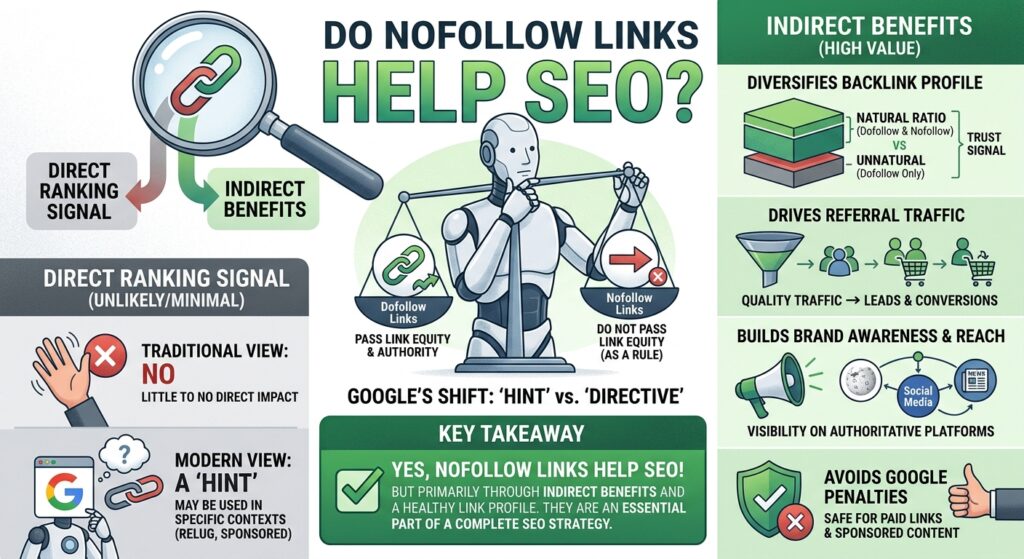
Nofollow links can feel confusing because they sit in a gray area. They are links, but they do not work exactly like regular followed backlinks. So when a business owner sees a nofollow link from a directory, social media platform, blog comment, press mention, or industry website, the first question is usually simple: do nofollow links help SEO, or are they just empty links?
At KSM Media Hut, we look at nofollow links with a practical mindset. They may not pass link equity in the same direct way as followed links, but that does not make them useless. A nofollow link can still support visibility, referral traffic, brand discovery, credibility, and a healthier backlink profile when it comes from the right place.
The key is understanding what nofollow links can and cannot do, and how they fit into a balanced SEO plan.
What is a Nofollow Link?
A nofollow link is a link with a small piece of code added to it. That code usually looks like this:
rel=”nofollow”
This tag tells search engines that the website linking out does not want to pass the same level of ranking signal through that link. It was created to help reduce spam and make link relationships clearer.
You may see nofollow links on:
- Social media profiles
- Blog comments
- Forum posts
- Press release websites
- Sponsored placements
- User-generated content
- Some business directories
- Large publisher websites
For a business, this can feel disappointing at first. You earned a mention, but the link is nofollow. Still, that link may have value beyond direct ranking power.
Do Nofollow Links Help SEO Directly?
Nofollow links usually do not help SEO in the same direct way as high-quality followed backlinks. A followed backlink from a trusted, relevant website can pass stronger authority signals. A nofollow link is more limited. But SEO is not only about link equity.
A nofollow link can still help when it sends real visitors, builds brand awareness, supports online trust, or helps people discover your content. If a potential customer clicks a nofollow link from a respected website and lands on your service page, that visit still matters.
At KSM Media Hut, we do not treat nofollow links as the main goal of link building. We treat them as part of the larger picture.
How Can Nofollow Links Still Support SEO?
Nofollow links can support SEO in several indirect but useful ways.
They Can Bring Referral Traffic
A nofollow link from a relevant website can send visitors to your page. If those visitors read your content, explore your services, or contact your team, the link has business value.
For example, a nofollow link from an industry blog may not pass strong authority, but it can still bring readers who are already interested in your topic.
They Can Increase Brand Visibility
When your business appears on trusted websites, people see your name more often. That visibility can lead to branded searches, direct visits, social engagement, and future mentions.
This matters because real brand demand supports long-term SEO growth.
They Can Lead to Followed Links Later
Sometimes a nofollow mention is the first step. A journalist, blogger, business partner, or customer may discover your website through that link and later mention you with a follow-up link.
That is why we do not ignore useful nofollow links. We look at the audience behind the link.
They Can Make Your Backlink Profile Look Natural
A healthy backlink profile often includes a mix of followed links, nofollow links, branded mentions, directory links, social links, and citation links. If every backlink looks overly optimized, that can raise questions.
A natural mix is common for real businesses.
When Are Nofollow Links Worth Having?
A nofollow link is worth having when it comes from a place your audience actually trusts or visits.
Good nofollow links may come from:
- Industry publications
- Local business directories
- Social media platforms
- Review websites
- Community websites
- Event pages
- Podcast show notes
- Partner pages
- Relevant forums or Q&A platforms
The question should not only be, “Is this link followed?” A better question is, “Can this link put our business in front of the right people?”
That shift changes the way we think about link building.
When Should You Be Careful With Nofollow Links?
Not every nofollow link is helpful. A link from a spammy website can still look messy, even if it is nofollow. Low-quality links from irrelevant websites, automated directories, comment spam, or scraped pages do not build real trust.
At KSM Media Hut, we focus on relevance first. A link from a small but trusted niche website may be more useful than a random link from a large website with no connection to your business.
This is where smart SEO strategy matters. Link quality is not just about metrics. It is about context, audience, topic match, and trust.
What Is the Difference Between Nofollow, Sponsored, and UGC Links?
Google now recognizes different link attributes that help explain why a link exists.
Nofollow
Use nofollow when you do not want to strongly associate your site with the linked page or when another tag does not fit.
Sponsored
Use sponsored for paid links, ads, sponsorships, affiliate links, or commercial placements.
UGC
Use UGC for user-generated content, such as comments, community posts, or forum links.
For business websites, these tags help keep outbound linking cleaner and safer. If you publish guest posts, accept comments, sell placements, or manage resource pages, using the right tag protects your site from unclear link signals.
Should You Build Nofollow Links on Purpose?
You should not build nofollow links only for ranking power. That is the wrong reason.
But you can include nofollow opportunities in your broader visibility strategy when they make sense. For example, being listed on a respected business directory, getting mentioned in a relevant article, adding your website to social profiles, or joining a professional community can all be useful.
The best SEO work connects search visibility with real-world business presence. That is why KSM Media Hut combines technical SEO, content planning, authority building, and Semantic SEO instead of chasing one link type.
How Do Nofollow Links Fit Into AEO and AI Search?
Search is changing. People now discover businesses through Google, AI Overviews, ChatGPT-style tools, voice search, maps, social platforms, and review websites.
Nofollow links may not be the strongest ranking signal, but brand mentions across trusted sources can still help people and systems understand who you are, what you do, and where your business fits.
For answer engines, clarity matters. Your website, service pages, profiles, citations, and content should tell a consistent story. That is one reason we build AEO strategies around clear answers, strong entities, and trustworthy brand signals.
What Should You Focus on Instead of Chasing Link Labels?
Rather than worrying about every link tag, focus on the quality of your overall SEO foundation.
A stronger plan includes:
- Helpful service pages
- Clean technical SEO
- Strong internal linking
- Clear topic authority
- Local citations where relevant
- Useful blog content
- Accurate business information
- Natural mentions from trusted websites
- A balanced backlink profile
Nofollow links can play a role, but they should not carry the whole strategy.
Frequently Asked Questions (FAQs)
Do nofollow links pass authority?
Nofollow links are not designed to pass authority the same way as followed links do. They may still be treated as hints in some search contexts, but they should not be counted on as direct ranking boosters.
Are nofollow backlinks bad?
No. Nofollow backlinks are not bad by default. They can bring traffic, brand exposure, and trust when they come from relevant websites.
Should I remove nofollow links from my backlink profile?
Usually, no. A natural backlink profile often includes nofollow links. Removal is only worth considering when links come from spammy, irrelevant, or suspicious sources.
Do social media links help SEO if they are nofollow?
Social media links may not pass traditional link equity, but they can drive traffic, increase visibility, and support brand discovery. That can still help your broader marketing performance.
Is a nofollow link from a high-authority site useful?
Yes, it can be useful if the site has a real audience and the mention is relevant. The value may come from referral traffic, credibility, and exposure rather than direct ranking power.
How many nofollow links should a website have?
There is no fixed number. A natural backlink profile usually includes a mix of followed and nofollow links. Quality, relevance, and context matter more than a specific ratio.
Build a Link Strategy That Looks Beyond One Tag
So, do nofollow links help SEO? They can help, but usually in indirect ways. They may support referral traffic, visibility, brand trust, content discovery, and a more natural backlink profile. They are not a replacement for strong, followed backlinks, useful content, or technical SEO.
At KSM Media Hut, we look at nofollow links through a business lens. If a link helps the right audience find you, understand you, or trust you, it has value. The smarter move is to build a complete SEO strategy where every link, page, mention, and answer supports a clear growth goal.
Ready to improve your backlink profile and build a stronger search presence?
- By admin